


Your Website Exists — But Does Anyone Know?
Updated: Mar 18
DIY websites vs professional - Why building a website correctly is the difference between being found and being invisible online.
A well designed website is great, but Google and AI don't look at pretty, they look at structure.
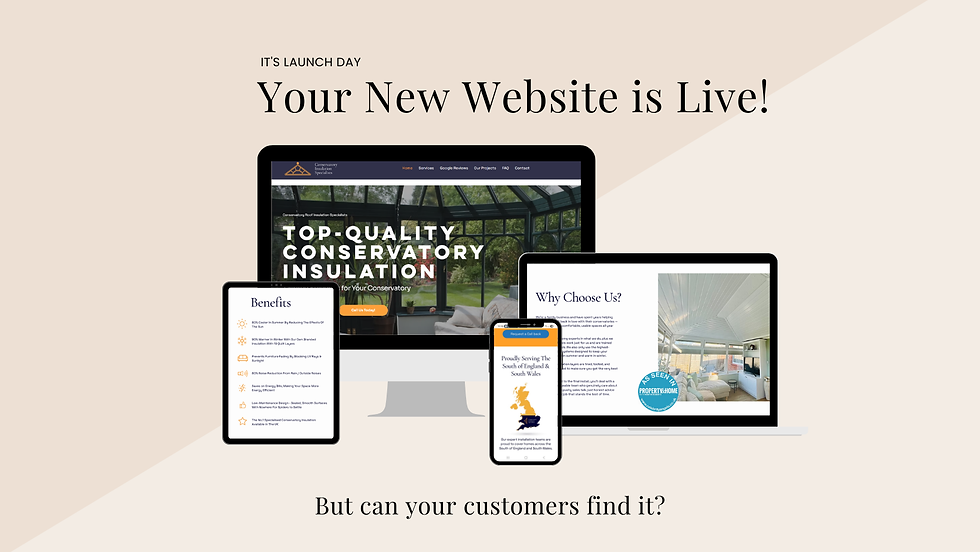
It has never been easier to build a website. Drag-and-drop platforms, ready-made templates, and AI site builders have handed the keys to anyone with an internet connection and a weekend to spare. And that’s genuinely exciting — small business owners can get online fast, on a budget, without needing a developer.
But here’s the question nobody asks until it’s too late: once your website is live, who is actually going to find it?
Because having a website and having a website that works are two very different things. One ticks a box. The other drives real business. In this post, we’re going to break down the pros and cons of building your own site versus working with a professional web design partner — and why getting it right from the start saves you far more time, money, and frustration than you’d imagine.
The DIY Website: Tempting, Fast — and Full of Hidden Traps
Q: Can I just build my own website with a template?
A: Yes, you absolutely can — and platforms like Wix, Squarespace, and Shopify make it genuinely straightforward to get something live. But ‘live’ and ‘working’ are not the same thing. A template gets you a website. It doesn’t get you found.
The Pros of DIY Website Builders
Low upfront cost — most platforms start free or at a low monthly fee
Fast to launch — you can be live in hours or days
No coding or marketing knowledge required
You have full control over content from day one
Built-in hosting, SSL, and basic security included
The Cons — and Why They Matter More Than You Think
Templates are not built with your business goals in mind — they’re built to look good in a screenshot
SEO is almost always an afterthought — page titles, meta descriptions, site structure, and keyword strategy
Google indexes poorly structured sites lower, or not at all
Mobile experience is often broken or clunky without careful testing
Analytics and tracking tools are rarely set up correctly if at all, so you can’t measure what’s working
No conversion strategy — visitors land and bounce because there’s no funnel
Your brand may look inconsistent or amateur, undermining trust immediately
Scaling or updating the site becomes increasingly messy and costly over time
The biggest hidden cost of a DIY website isn’t the platform fee or the pretty design. It’s the time you spend on it, the customers you don’t get because they can’t find you, and the eventual cost of rebuilding it properly once you realise it isn’t delivering.
If Nobody Finds You, Does Your Website Even Exist?
Q: Does it matter how a website is built, as long as it looks good?
A: Looks matter — but they’re not enough. A visually stunning website that isn’t optimised for search engines is like opening a beautiful shop in the middle of a field. Google is your high street. If your website isn’t built to rank, you won’t appear on it.
Think about how you find businesses. You Google them. Your customers do exactly the same. And Google’s algorithm doesn’t care how nice your colour palette is. It cares about site speed, mobile responsiveness, structured data, content quality, keyword relevance, metadata, internal linking, backlinks, and dozens of other technical factors.
A website built without SEO knowledge baked in from the very start is already fighting an uphill battle. Retroactively adding SEO to a poorly built site is like trying to add foundations to a house that’s already standing — it’s far harder, more expensive, and often requires starting again anyway.
Q: What does ‘built correctly’ actually mean for SEO?
A: It means your site structure tells search engines exactly what your business does and who it serves. It means every page has a purpose, every URL is logical, every image has alt text, your page speed is optimised, and your content answers the questions your customers are actually asking. It means analytics tracking is set up from day one so you can measure, learn, and improve.

The Real Cost of Getting It Wrong
Q: What happens if my website isn’t built correctly?
A: At best, you’ll have a site that looks fine but generates no enquiries. At worst, you’ll spend months wondering why your marketing isn’t working — not realising the problem was the foundation all along.
Here are some of the most common outcomes we see when businesses come to us after a DIY build or a cheap-and-cheerful web job:
Site ranks on page 3 or beyond for all relevant search terms — effectively invisible
Google Analytics not connected, so there’s no data to make decisions from
Paid ad spend wasted because the landing pages don’t convert
Mobile layout broken, causing high bounce rates and lost trust
No clear call to action — visitors don’t know what to do next
Duplicate content penalising search rankings without the owner knowing
Site speed too slow — Google actively ranks faster sites higher
Brand inconsistency undermining credibility with potential customers
Every one of these issues has a cost — either in lost business, or in the time and money required to fix it. And often the cheapest solution is to rebuild from scratch. Which is exactly what you were trying to avoid.
What Does a Professionally Built Website Actually Give You?
Q: What’s the difference between a template website and a custom-built professional website?
A: A template gives you a starting point. A professionally built website gives you a strategy. It’s designed around your specific business goals, your target audience, and how people actually search for what you offer. It’s built to rank, to convert, and to grow with you.
A well-built website isn’t just a brochure — it’s your hardest-working salesperson. It should be generating leads, building trust, and moving visitors toward a decision 24 hours a day, 7 days a week. That only happens when every element — design, copy, structure, speed, SEO, UX — has been considered together.
What a professionally built website includes:
Custom design aligned to your brand and business objectives
SEO-optimised structure from the very first page
Mobile-first, fully responsive layout across all devices
Fast load times built in from the ground up
Clear user journeys and conversion-focused design (UI & UX)
Google Analytics, Search Console, and tracking set up correctly
Content strategy that targets the right search terms
A site that supports your advertising, social media, and email efforts
Scalable architecture that grows with your business

What Makes Fresh Mix the Best Partner For You?
Q: Why should I choose Fresh Mix Digital to build my website?
A: Because we bring together two things most web agencies separate: exceptional design and deep marketing expertise. With 20 years of experience, we don’t just build websites that look great — we build websites that perform.
At Fresh Mix Digital, every website we build is treated as a business tool first and a design project second. That means every decision — from the structure of your navigation to the placement of your call-to-action buttons — is made with your business goals in mind.
🌐 Google Partner | Wix Partner | Meta Partner
Fresh Mix Digital is proudly recognised as a Google Partner, Wix Partner, and Meta Partner — a combination that means we’re equipped to support your website alongside every channel of your digital marketing strategy.
Ready to Build a Website That Actually Works?
If you’ve been sitting on a website that isn’t delivering — or you’re starting from scratch and want to do it right — let’s talk. One conversation could be the difference between a website that exists and a website that grows your business.
